
Bond yields are back at levels many investors haven’t seen in two decades. The 10-year Treasury moved above 5% this month, and high-quality corporate bonds are paying in a similar range. For the first time in years, bonds offer both liquidity and meaningful yield.
That raised a fair question during our Q3 Private Credit webinar yesterday. With bonds paying 4 to 5.5%, does it still make sense to move up the risk curve into private credit?
I’d start by saying bonds still matter.
The case for bonds, and what they cost today
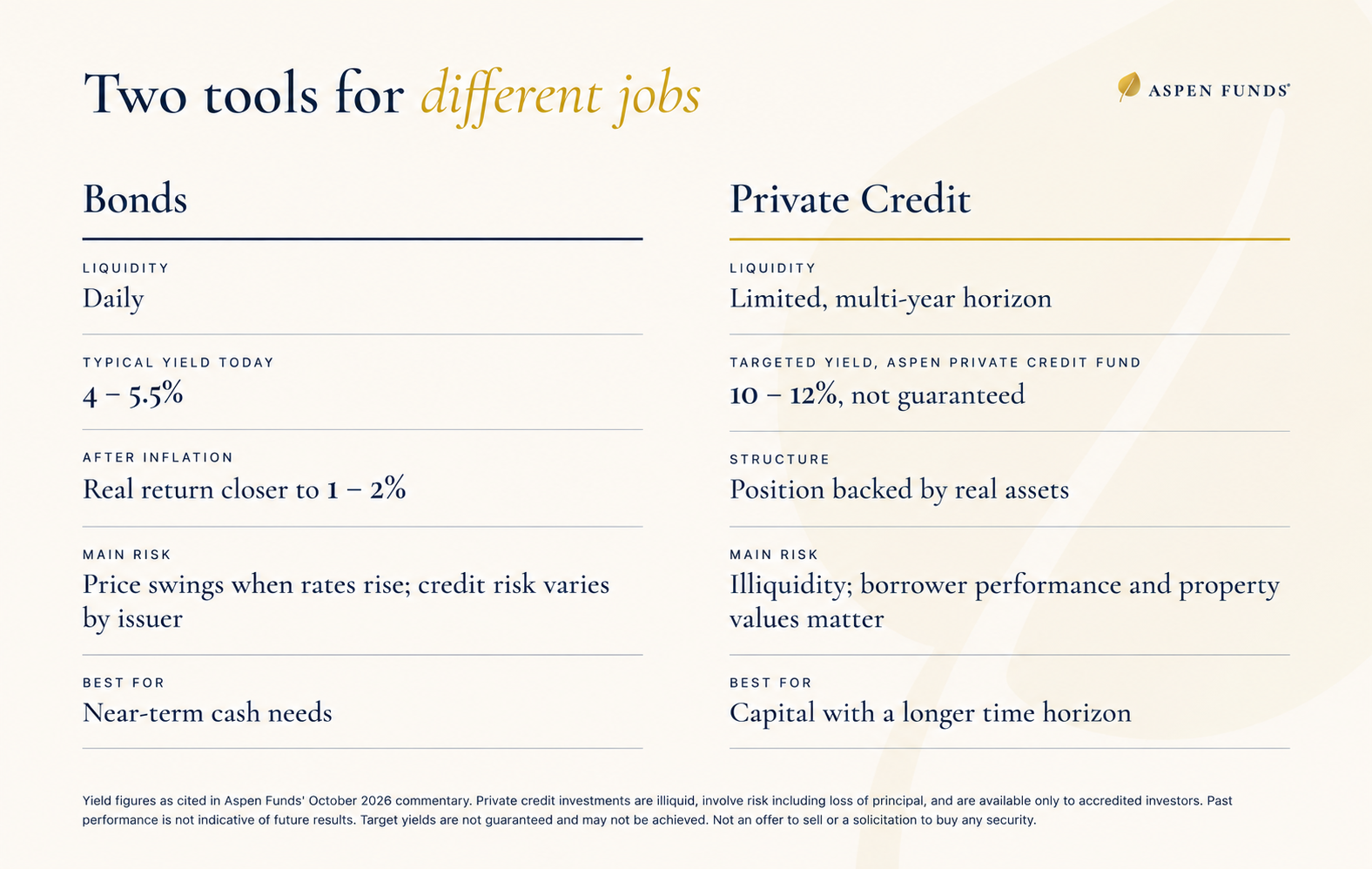
Bonds offer daily liquidity, transparent pricing, and stability when other assets are under pressure. Capital you may need in the near term belongs in liquid instruments.
But the headline yield only tells part of the story. After inflation, the real return on a 5% bond is much closer to 1 to 2%, and lower still after taxes on ordinary income. Bond prices have also been sensitive to rising rates this year, so that income hasn’t always turned into total return.
When to consider private credit
Private credit is a different tool, not a riskier bond. You give up liquidity. In exchange, you hold a position backed by real assets, with contractual income and a yield premium over public markets.
In my view, the trade-off generally makes sense when:
- Your near-term liquidity needs are already covered elsewhere
- The capital has a multi-year time horizon
- The goal is income that meaningfully exceeds inflation
For investors in that position, we believe a measured allocation can improve the risk-adjusted income profile of a portfolio. It doesn’t replace bonds. It sits alongside them.
If you’d like the longer version, we wrote it up here: Replacing Bond Yield with Private Credit. And if you missed the webinar, you can watch the Q3 performance recording, where Ben Fraser and I walked through how the Aspen Private Credit Fund is positioned today and how we structure each investment to protect capital.